Direct resin venering
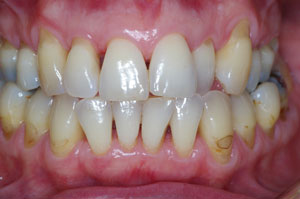
A 41-year-old woman asks for cosmetic treatment of tooth 22. This tooth is positioned so far palatally that it is placed in cross-bite, (without occlusal interferences).
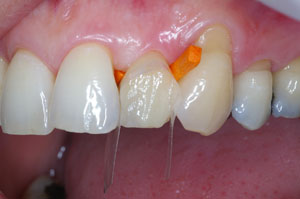
Tooth 22 is, as it were, in the shadow of the neighbouring elements and therefore appears darker.
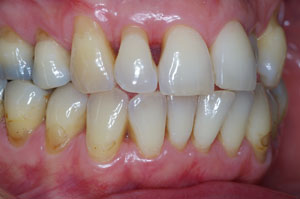
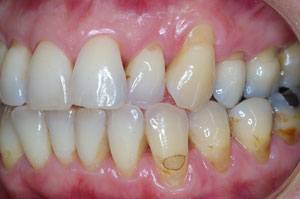
After initial periodontal treatment some years ago, there has been some recession of the marginal gingiva. This gingival recession further emphasises the fact that tooth 12 is narrower cervically than tooth 22, partly because of the dark triangles formed by the dark background of the buccal cavity.
The patient does not wish any orthodontic treatment, so the only treatment option is to creatively mask the shape and position of teeth 12 and 22. After making a mock-up with composite, it is decided in consultation with the patient, to build up tooth 22 in labial direction by means of a direct composite veneer restoration. Tooth 12 will be built up very locally in proximal direction in order to mask the dark spaces. |
| |
 |
 |
 |
| |
1a. Frontal view of patient with tooth 22 positioned 1alatally and moderate gingiva recession |
1b. View from the right. Tooth 12 showes cervical constriction and interdental papillae are flattened |
1c. View from the left. Tooth 22 is wider than tooth 12 and is in cross-bite |
| |
 |
 |
| |
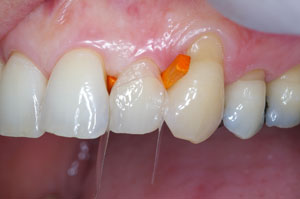
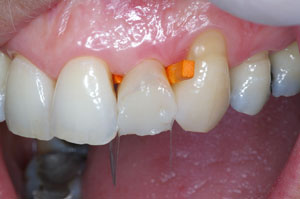
2a. A layer of dentine composite is applied, shade OA2 |
2b. A layer of composite in shade A3, which continues to the cervical outline, ensures the warm, yellowish aspect in the cervical are |
| |
 |
 |
| |
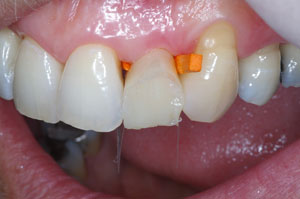
2c. A thin layer of A2 is applied, overlapping, further towards the incisal edge, which provides the basic colour in the central area (less colour saturation, slightly higher value) |
2d. Finally, D3 is applied in over lapping layers to produce less saturation towards the incisal edge and provide a slightly bluer aspect (again slightly less colour saturation and lower value) |
| |
 |
 |
| |
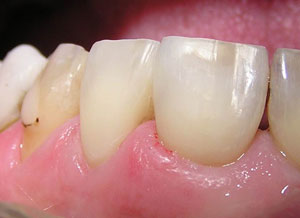
3a. An example of composite restorations on teeth 21 and 22, which have been contoured using fine diamond finishing burs |
3b. The same restorations as in fig. 4.a, but now finished using a multifluted carbide bur |
| |
 |
 |
| |
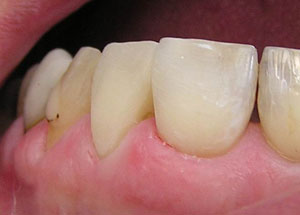
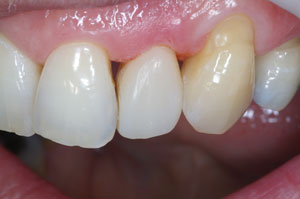
4a. Final result of a veneer restoration on tooth 22, immediately after treatment. Light reflections on element 22 are symmetrical and parallel with adjacent teeth |
4b. Close-up of a veneer restoration on tooth 22. The surface texture structure is visible more clearly |