FAQ en Tips
1) How can colours best be matched?
By using a Shade Guide made of real composite one best selects the colour.
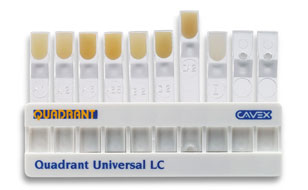
Also making a so-called mock-up is a very secure way of determining the exact colour; A mock-up can be made by applying the selected colour on the element without bonding. Polymerise the composite. Because no bonding is used the composite can easily be removed using an instrument.
Tips:
- There is a slight colour change following polymerisation (lighter or darker)
- Colour changes slightly as a result of polishing
- Dry elements, as a result of cotton rolls and cofferdam have temporarily a slightly lighter colour.
2) Can Quadrant Universal LC and Quadrant Anterior Shine be combined?
YES, because of the same chemical composition, barium glass fillers, matching fluorescence, both composites are a PERFECT MATCH.
Quadrant Universal LC is best used as a strong bases and Quadrant Anterior Shine as a perfect finish. Both materials are easily high gloss polished and of excellent aesthetics.
3) Why should different colours of composite be applied in layers and not mixed?
When composite is mixed there is always the risk of incorporation of air bubbles.
4) Why use opaque colours OA2 and OA3,5?
To mask discoloration it is advised to use an opaque colour first. Because of the dense coloration of an opaque composite the underlying discoloration is blocked from "shining" through.
Also when there is no/little dentine left an opaque colour is best used to restore the natural look of the element.
5) Avoid visible edges
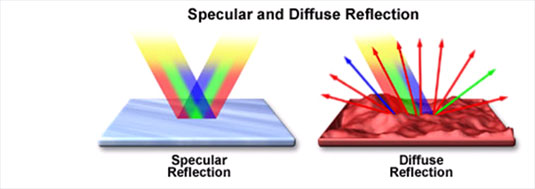
Often visible edges in composite restorations are caused by use of the "wrong" composite. A lot of composites have filler particles with the wrong shape or from the wrong material and this makes that light is reflected in a straight angle. Using Quadrant composites with prisma structured barium glass fillers, light is diffused and shattered in every direction, similar to natural enamel reflection. This makes that the composite and enamel fuse together naturally and the restoration is invisible.
6) Why is Fluorescence important?
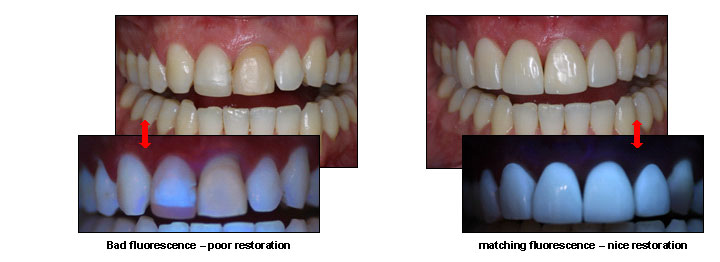
Natural enamel has a certain fluorescence. If a composite deviates strongly from this fluorescence, more or less light is reflected. As a result the aura of the restoration deviates from the surrounding enamel and the other elements. This causes the restored element to have lustreless aura (not shining, darkish or too bright). So, from an aesthetic point of view one better uses a composite with a matching fluorescence. Quadrant Universal LC and Quadrant Anterior Shine fluorescence perfectly match natural enamel.